Wednesday, 17 September 2008

Marantz CD5003 CD Player

Replacement of the Marantz CD5001 (5 Stars What Hifi Award) entry level CD player has been replaced by the new year 2009 CD5003.


The MSRP of this again 5 Stars What Hifi award CD Player is RM 1,299. The design is major change from CD5001 with the new look of Marantz flagship SA-7S1 CD Player that retails at RM 24,999.
Marantz CD5003 Silver-Gold.jpg


The look definately looks more muscular and it weighs 5.1kg as compared to 3.7kg on the CD5001. Other than the look, there a quite a number of changes too.
Marantz CD5003 Black - Rear.jpg


It is using the DV11VF mechanism, TC94A70FG decoder that supports MP3 and WMA format. Utilizing an EI power transformer and consumes 14W as compared to 12W on CD5001. DAC remains the same CS4392. Marantz added the HDAM-SA2 for the output buffer. Channel separation is at 110 dB now as compared to 100dB.


For choice of color, there are Black and Silver-Gold. No more silver color.
Marantz CD5003 Black.jpg
For the msrp of RM1,299, it is definately a BEST BUY item and value for money on all the new features and construction of this new beast!


Why wait? Be the first to own it Now! Place your order now at Sound Fusion Sdn Bhd. Contact +6 082-420020. MSRP is before discount.

Tuesday, 16 September 2008

Loud means Good??

It is funny we always hear people who bought consumer brands sound system for a price ranging from RM699 to RM 5,000 showing off on how loud their system can achieve. They have no clue on what sound system or music system means to them. If they want LOUD loudspeakers, why don't just get those Big Black Box Speakers from P.R.C. that cost them RM199 a pair and blast the ear drums out of their neighbours.


Then comes another set of tiny speakers system that cost you over RM3500 a set that simply asking buyer to pay for their high priced advertisement fee. How can such a small speaker do anything good other than producing high frequency sound? Sorry no mid tone or low bass. All high out with only a subwoofer to conpensate for the mid and low. Why would somebody spends their money in this?


Behind the beautiful black finish with a touch of modern look lies compressed or recycle wood and plastic. They may look big and solid but it is light and hollow. When you send one to the service center, you usually get the same answer "I'm sorry but the main circuit board needs replacement" which usually cost you 60% of the new product. And most of all, they will charge you RM80 to RM120 regardless if you are going to repair it or not. Ouch !!


So, think twice before you consider buying these consumer brands simply because they are "cheap"? or "CHEAP"??

Denon AVR-1909 (5 Stars WhatHifi)

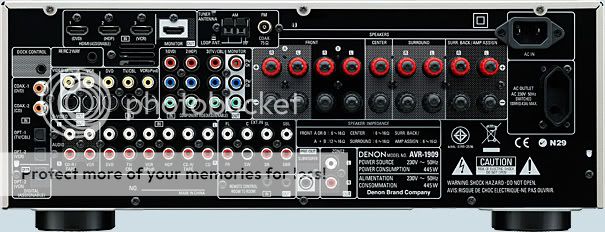
Denon AVR 1909.jpgFinally, a budget AV Receiver that supports DTS HD by Denon is out ..The Denon AVR-1909 is priced at RM3,299 msrp is a 7.1 channels AV Receiver that supports DTS-HD with video up-conversion to 1080p.


It supports not only Pro-Logic II, IIx, Dobly Digital EX, DTS Neo:6, DTS-ES, DTS 96/24, Dobly Digital Plus but also DTS HD, Dobly TruHD and DTS Master Audio.


The AVR-1909 features Faroudja DCDi video processing and up-conversion, breathing new life into standard definition sources. With 3 HDMI v1.3a input, it supports video upscaling up to 1080p from composite, s-video and component video source.Denon AVR 1909 Rear.jpg


An extra feature in the AVR-1909 is the Audyssey Dynamic Volumne automatic volume-leveling system where it helps eliminate irritating swings in volume between TV shows and commercials. The Audyssey Dynamic EQ also ensure rich bass and smooth tonal balance, even at low volume levels.


Denon AVR-1909 is being rated with 5 stars by WhatHifi.


So? Why wait? Get it at Sound Fusion Sdn Bhd located at 3rd Floor Wisma Satok, Kuching, Sarawak. Malaysia. Tel: +6 082-420020

Denon AVR-1509 (Year 2009 Model) is HERE !

Denon AVR 1509.jpg The all new Denon AVR-1509 (Year 2009 model) is here. When it comes to home cinema sound, Denon is one of the best in the home theater brands. Denon has been awarded with many WhatHifi awards (whathifi.com) with its high end receivers and amplifiers. Nevertheless, Denon has never neglected the lower end market and by providing entry-level models such as this AVR-1509 at an affordable price of RM1,799 msrp, most of us can enjoy quality sound from this solid built AV Receiver without worrying a bigger hole in our wallet.


Like the previous model AVR-1508, this is a 7 channels AV Receiver that produces 75watts (8 ohms) x 7 channels power. You get to enjoy DTS surround sound, Digital EX, ProLogic II/IIx, ES Discrete6.1 and ES Matrix 6.1 sound. It supports 2 HDMI 1.3a input and 1 HDMI 1.3a output for your LCD, plasma or project with HDMI input. Denon AVR 1509 Rear.jpg


The only downside of this AVR-1509 is that it does not come with the video upscaling features as compared to the higher model AVR-1709. There is no audio transfer via HDMI from your Bluray dvd player. The component video bandwith is also rated at 30Mhz only and there is no bi-amp supports for your speakers.


However, at a price tag of RM1,799 msrp, this is a highly recommend equipment for entry-level user. So? Why wait? Get it at Sound Fusion Sdn Bhd located at 3rd Floor Wisma Satok, Kuching, Sarawak. Malaysia. Tel: +6 082-420020


Monday, 15 September 2008

Why Sound Fusion?

Buying a set of new home theater system is a big decision, and with so many options and brand names available, how do you decide which one is right for you?


At Sound Fusion Sdn. Bhd., we can provide the information you need in finding the most suitable home theater set according to your budget.


An expensive home theater does not always out perform a cheaper one. The formula is how to match the speakers with the amplifier or receiver.


I have seen and known too many people who have spent their hard earned cash into consumer brand, didn't realize they are just wasting their money in buying those all-in-one system. I will go into more details on why those systems are totally a waste of cash and investment.


Problem with most consumer brands all-in-one system is over heating problem with the amplifier and the build in dvd player. Most of them are having heat issue where user cannot use it for extended period of more than 3 -4 hours. You will notice image degration and sound distortion after 3 -4 hours. Some dvd will start to skip chapters or experiencing occassional pauses throughout the tracks. Continue to operate will cause serious damage to the system.


That is why audio specialist chooses standalone av receiver/amplifier/dvd for durability. You pay a little more BUT you use it longer (more than 10 years on most cases).


This blogspot brings your awareness on why you should save enough for your next system rather than throwing your money into the drain when the all-in-one system goes into waste after couple of years.


Do the math !

Wednesday, 11 June 2008

The Misunderstood Aspect of your Screen Shape

Nearly everyone has been into a store and seen the new, huge HDTV sets. At some point, we probably notices that the screen is more rectangular than square, and while this fact may have made a small impression, the reasons why, and the impact of the new shape may have gone right on by us. Here’s some help.

So what do we call it? To call it rectangular is not very specific. Just how rectangular is it? To define its shape in a number to two, it’s been reduced to a ratio of width to height. A standard TV has a width to height ratio of 4:3, which can further be reduced to 1.33:1. Sometimes this is just stated as 1.33, assuming the “:1” part as understood. That aspect ratio came from the early days of movies, when the screen size was picked. It was standardized as 1.33:1 nearly 100 years ago, in 1907, when the fledgling film industry recognized the need to set a standard film size and frame shape. Yet, even as early as 1897 there were experiments with wider screen shapes. But big changes really happened in the early 1950s, when TV began to supply to the consumer the bane of movies existence: free entertainment. To the TV boys it made perfect sense to make the screen the same aspect ratio as movies, since there would probably be a lot of film shown on TV. But size and shape aside, TV did one thing very well…it caused theater ticket sales to plummet. The movie industry was desperate to save itself in any way it could. It stepped up the production of color films, but TV responded by announcing that it too would soon be in color. The movies only real option was to build on the physical size of their screen, to emphasize that a movie was more of a special experience than just entertainment. So, out of desperation, the movie industry developed ‘wide screen’ movies. But since wide screen was more of a knee-jerk reaction than a well-planned strategy, there were many different systems, film formats, and aspect ratios tried. The names of these processes are entertainment in themselves: CinemaScope, Cinerama, Panavision, Super Panavision 70, Technirama, Todd AO, VistaVision, and more. (My favorite one is “Cinemiracle”…just the name, not the wide screen process). Enough to fill a book! And in fact, it did. You can buy “Wide Screen Movies – A History and Filmography of Wide Gauge Filmmaking” by Robert Carr and R. M. Hayes on Amazon.com for the full story. It’s an exhaustive studio of the wide screen movie concept, the variations, screen sizes and shapes, and the people that invented them (or in many cases just copied from others!) While much of the book is an extensive filmography of each wide screen process, the stories of the development of these formats is nothing short of fascinating, though possibly not quite worth the hefty price of the book.

But back to wide screen movies. Since each process was somewhat different, and movies had to show on thousands of theaters, there had to be at least some standards. Two methods proliferated above all others. Generically known as “Scope” (from CinemaScope), but used to refer to any film made with an anamorphic process, the screen became 2.35:1. The film is shot through special lenses that squeeze the image horizontally by 2X, then re-stretch it during projection to take a 1.18:1 film frame (yes, it was more square than even 1.33) out to 2.35. The various squeeze/stretch amounts were eventually standardized, and we now have “Panavision”, a company that makes equipment used to produce the current most popular “Scope” format. But, since 2.35 was quite wide, and some theaters couldn’t even show the full width properly, and since there are limitations in cinematography imposed by the special lenses, the Academy of Motion Picture Arts and Sciences chose to standardize an in-between aspect ratio of 1.85:1 (known today as “flat” in the film world). It requires no special lens, and is achieved by masking off the upper and lower parts of a 1.33 frame by using an appropriate aperture plate in the projector. Cheap, easy, and at no additional cost…the film industry embraced it wholeheartedly. With very few exceptions, all films made today are either 2.35:1 “scope” (anamorphic) or 1.85:1 “flat”, and shot on 35mm film.

Fast-forward to HDTV. The TV industry had long experienced the difficulty of showing a 2.35 scope film on its 1.33 screen. You’ve seen “letterboxed” versions, panned and scanned versions, and just plain bad cropping where one of the key actors is on screen in the theater, but off screen on TV. Since every theatrical film made in the last 40 years was at least 1.85, but TV was standardized at 1.33 over 50 years ago, broadcasters had a problem, and with new standards being developed for HD television, they had a chance to solve it. But the problem proved more thorny than anyone though. Introducing a new standard aspect ratio in TV would alienate old TV viewers. You’d have the cropping and pan/scan issues all over again, but this time on every program all day long, not just movies. It would have made sense to pick an HD aspect ratio that matched Hollywood’s 1.85 standard, right? But broadcasters know about compromise, and being worried about letterboxing a standard image within a 1.85 frame, they chose a compromise of 16:9, which reduces to a rather inconvenient ratio 1.7777777:1 (the 7’s go on forever). Now, you have to wonder what drove this. And the simple answer is, it's related to the problems of scanning the front of a picture tube with an electron beam, and getting it to work into the corners of the tube. Yes, it's rooted in a display technology that virtually vanished once 16:9 flourished. Sure, as HDTV slowly penetrated the market, for a time there would be two side bands when a 1.33 image was shown on a wide screen TV, but soon every TV made would have the new wide screen, and eventually 1.33 sets would go away. But rather than match the prevailing 1.85 standard, they picked the 1.77 compromise because it results in a little letter box to show 1.77 on a 1.33 set, and a little vertical letterbox (pillarbox) to show a 1.33 image on a 1.77 set. Neither is optimized, and when you see a real wide screen ‘scope film, it’s always a large letterbox. Actually, my personal theory is that Broadcasters picked 16:9 because it matches the aspect ratio of the original Star Trek series View Screen. Hey, it's as valid a reason as any other given.

Simply put: they goofed, big time. They compromised the long term aspect ratio by catering to a short term problem. It turns out nobody likes to see a letterboxed image, and constant display of a letterboxed image will actually burn a letterbox into a TV screen, so TV manufactures developed their own compromise: stretching. If you have a new HD set and have a standard image to show, the set can stretch it to fit the new wide screen…and in doing so add 30 pounds to every actor or actress, distort the image, and mess up the cinematographer’s composition. You’d think this would be something any viewer would object to, but go into any TV store and you’ll see one stretched image after another. Go into any sports bar and you’ll see more of the same. In fact, we were shocked recently to go into a Sushi bar and see a nice non-stretched 1.77 HD image TV program with 1.33 aspect commercials, just as it was meant to be…at least in the world of broadcast television.

So that’s the story. It’s a compromise, and a poor one. But there are solutions! You can still see a 2.35 wide screen movie letterboxed inside your 1.77 screen. Several projector manufacturers are now making equipment designed to utilize the anamorphic images found on some DVDs and make them fit a real 2.35 screen. When this is done with HD DVD or BluRay DVDs, the result should be real, honest to goodness, 2.35, ‘scope, Panavision, CinemaScope, Technirama images on your home screen. That’s your own, home, 2.35:1 aspect ratio screen! And what to do about 1.85 or 1.33 material? How about motorized masking curtains that make your screen the right shape for every format. It’s available. Today. From Platinum Home Theaters.

If you’re interested in taking the ‘wide view’, give us a call, and we’ll help you do it. In fact, we look forward to it!

For more information on wide screen projection in the home, call Platinum Home Theaters at 708-588-0880.

Tuesday, 15 April 2008

5.1 surround? 7.1 surround? Bah! 10.2!!!!

I've heard the future of audio, and it is 10.2!

We've all by now heard of 5.1 channel surround, and the greater percentage of home theater sound systems are capable of playing that format. Most of today's home theater receivers are capable of 7.1 channel surround, though very few films are mixed with 7.1 channels. But what I heard goes beyond 5.1, beyond 7.1, to 10.2 channels.

Before you groan thinking "I can't put 3 front speakers where I want them, how am I ever going to place 12?", we have to go through a little analysis.

The logic goes: everyone can hear the improvement that stereo has over a single speaker mono. Similarly, the improvement between 2 channel stereo and 5.1 channel surround is also unmistakable. If you follow that line of progression, you'll notice that every time the channel count is doubled, the improvement is unmistakable. So, the next logical step past 5.1 is 10.2 channels…not 7.1, which would be an incremental step.

The Sound

The goal of all surround sound systems, from early 4 channel (Quad) systems to present day 7.1 channels is to wrap the listener in an immersive soundscape. It could be for ambience sound support of picture, or it could be used to provide a new perspective, such as a "front row" position at a concert, or a prized seat within the band itself, a position simply impossible to purchase a seat for. To a considerable extent, 5.1 channel systems do that, and create a sound space that wraps the listener in 360 degrees of sound…in a horizontal plane. So long as the speakers are mostly aligned for that horizontal 360 degree wrap, the sound field will be a thing of its own, a creation of a sound field, not the re-creation of an acoustic space.

The System

Enter 10.2 channel surround. Research has shown that the more precise the directional content of sound is, the more we perceive it as "real". What that means is, if you want a sonic image in a particular location, you need a speaker there. Early research into what became "stereo" seemed to indicate that for a 360 degree sphere of sound, you need a 360 degree sphere of thousands of speakers. Lacking that ability, compromises could be made that achieve most of the effect with far fewer speakers. 10.2 is the next logical step. Rather than limit the sound field to a basically horizontal plane, it adds the element of elevation with two high front speakers, and adds two forward side channels between the listener and the L and R speakers, and adds a single rear speaker directly behind you, along with a second subwoofer channel.

That's how 10.2 differs over 5.1, but what about 7.1? Here's a comparison:


5.17.110.2
Left/Center/Rightyesyesyes
L-surr/R-surryesyesyes
L-rear/R-rearnoyesno
L-side/R-sidenonoyes
L-high/R-highnonoyes
LFE-1/LFE-2nonoyes

Now, before you look at the chart and say "Look! 7.1 offers something 10.2 doesn't!", look closely. No, 10.2 does not have a Left and Right Rear, but keep in mind that Lr/Rr systems cannot reliably place a sound directly behind you. To do that they depend on a phantom image between two speakers, which only will exist if you are equidistant between two speakers playing exactly the same sound. That phantom image is fragile. Remember stereo? If you don't keep your head locked on the center-line between L and R, you won't have that firm center image of a vocalist. That means stereo has a small "sweet spot". Placing a center speaker between L and R creates a solid center, regardless of listening position. The rear speaker in 10.2 does exactly that, but behind you. The function of Lr/Rr from 7.1 is maintained by placing sound between Ls and Rear, for example. From a surround standpoint, 10.2 works like 7.1, but with a palpable rear image. That "no" in the Lr/Rr 10.2 column could really be a "yes".

What about two subs? Didn't you think subwoofers were omni-directional? Turns out, that's only true to a degree. Having two LFE channels adds dimensionality to bass while preserving the advantage of multiple subwoofers from an acoustic standpoint.

So, that's what it is. Impressed? Want to actually hear 10.2? You will have to take a little trip to San Antonio, TX. There's where you'll find Bjorn's (just Bjorn's) (http://www.bjorns.com) and their Ultimate Home Theater Experience demo room, with the only 10.2 system in a retail space. And it's a very special room and system, designed personally by Tomlinson Holman (inventor of THX, and the one who named 5.1 channel surround), and calibrated by him. In fact, he supplies the demo material, complete with his own personal introduction. The demo includes a marching band, orchestra (from both the audience perspective, and from a perspective within the orchestra) and a demonstration of the systems ability to reproduce the acoustic space of a large hall. One orchestral segment is the final few minutes of Aaron Copland's 3rd Symphony…an presentation so involving, so immersive, that it brought us to tears…quite literally. The final segment is a very fun 10.2 mix of a Herbie Hancock piece, with lots of electronic pings, fast multichannel pans, all to a lively bit of jazz. For storing the 10.2 material, there was a computer with Firewire audio interfaces, and a bit of software for playback.

There is no video to go with 10.2 at this time. In fact, the material available in 10.2 is limited to the demo selections, and possibly others from Holman's TMH Labs, the sole supplier of 10.2 at this moment. Of course, the new Blu-ray Disc has all the capacity needed for HD picture and 10.2 channels of audio in PCM or DTS (which supposedly can support up to 2,000 channels!). There's a bit of a problem getting 10.2 out of a player right now, but providing a bit-stream output is a start.

So, you want one, right? So do I! And, quite honestly, if you don't mind waiting for more music, or even better, have the budget to commission 10.2 recordings, Platinum Home Theaters would be more than happy to build a system for you…right now. We'll also be happy to arrange for and produce those recording sessions for you. Of course, when we say budget, it's not for the squeamish. But if you REALLY want immersive audio, this is THE way to get it.

There is simply no way to describe the experience of 10.2 in words. I know, because I've been trying to for several years. You just need to pop for a weekend in San Antonio. Bjorn's is a short cab ride from the airport, and downtown San Antonio is only about 10 minutes away from the store, with its picturesque River Walk, dinner cruises around the narrow canals, restaurants with live jazz, and world class hotels. Make a weekend of it…but the highlight, I promise you, will be 10.2.

Stand by…10.2 will get here. It's already had a start of the best part of a decade. We just need to wait for those other 5.1 and 7.1 slow-pokes to get out of the way!