Monday, 19 April 2010

Wanting to connect your MacBook & Plex to the TV - this is what you need! Henge Dock is awesome!

Click here for the Engadget review or read below:

Henge Docks: finally, a well designed docking station for Apple's MacBook line

We'd love to say that many have tried, but really, the bona fide docking station market dried up years ago in every sector save for enterprise, and while a few companies have served up "universal" alternatives, none of them were particularly well-designed. Out of nowhere, Henge Docks has emerged in order to provide a solution to your MacBook docking woes, and we've got to say -- for a first try, the products being offered up here look mighty fine. Designed to work with most modern MacBooks as well as 13/15/17-inch MacBook Pros, these all-white stands hold your machine vertical while providing seamless access to desk-strapped peripherals (a monitor, iPod dock, mouse, heated USB blanket, etc.) It also uses Apple's own MagSafe adapter, and your optical drive is still flipped out if you need to access it. The 13-inch MBP model is available now for $59.95 to $64.95, while every other flavor is available for pre-order; check out a video after the break if you're having issues pulling the trigger.


Tuesday, 30 March 2010

A "Poor" Rich TV buyer

I feel sorry for those who had spent thousands of dollars on a TV regardless it being LCD, LED, Plasma and ended up watching RM5 "backup" DVD or even Astro. The recent release of Astro Beyond had triggered a lot of consumers in the market changing to new full HD LCD, LED and Plasma. But without any technical knowledge or what so ever, they went to a electrical shops and did some survey, price compare, listen to the salesman talking a bunch of ; most of the time rubbish and spend on something they don't usually need to play their low quality picture.lg_xcanvas_david_led_3-thumb-450x307.jpg samsung led tv review.jpg


Maybe not in West Malaysia, but I notice here in Kuching, there are a lot of uncles and aunties buying new tv but in the end, complain about why the quality isn't as great as what they see in the electrical shop. Most of us know, you can't expect your RM15K 50" LED to give you superb quality when you are only playing RM5 DVD, or even the 480 or 720P Astro channels. In the end, you are paying for something that you don't use. It's like buying a Ferrari in Kuching but no place to drive. No doubt some people are buying to show their "status" rather than to show the Picture Quality. I feel sorry for them again.

There is a simple trick most electrical stores are pulling it on consumers. They use Media players like Tvix and popcorn to stream the media to their displayed LCD, LED and Plasma. Most customers see the great PQ and expect to get the same quality once they replace their old CRT. You can call it a scam or lie, but that's the only way to sell your TV and I can't blame the sales person because they are only trying to earn a living and the customers are trying to buy a new TV.

A Simple Check List prior to buying your TV:

  1. What source are you planning to feed to your tv? (astro, dvd, bluray, media from internet (mkv, m2ts, rmvb, avi)
  2. What is your budget? (<3K, <5K, 10K, etc)
  3. Environment you are using the tv ? (living rooms with lots of windows and reflection? or dedicated av room?)
  4. Sitting distance between you and your tv? (some people are buying 50" and sit 20 feet away; should have got 40" and sit 8 feet away)

Next time, before your friends and family want to buy a tv, ask them what kind of source they are going to feed to their new tv first. If they said RM5 DVD or Astro, ask them to save the money and spend it on Sound System!

The First Ultimate MK II by Van Den Hul

vdh_first_ultimate.jpg


I've been selling audio interconnect aka RCA cables from most brand names since I started this business. I've never brought in anything above the retail price of RM1000 due to the spending power at my old shop (Wisma Satok). Late last year, I've been bringing in more higher end RCA interconnects especially from Van Den Hul. Tried The Wave, The Bay, The Name and D102 MKIII which are all very good quality interconnects. I personally like Van Den Hul product from the feel and touch. Most importantly the printed "Made in EU" words on the rubbery texture on most of their cables.

Although the price is slightly higher when compared to other brands I have in my shop, I highly recommend their product. The First Ultimate MKII interconnects from VDH is made of metal free material ..."carbon". So technically, it should last a life time since there's no metal for degrading over times. Out from the box, I plug hook it up to my Marantz KI series (Int Amp + SACD) together with Proac Studio140. It brings MUSIC to life !! The sound stage is awesome and very noticable that even a non-stereophile can notice it straight away.frst-uL-Main.jpg


Musical instruments seem to be closing into my ears. I can only describe The First Ultimate as being "MUSICAL" and great sound stage. Comparing to D102MKIII, it seems to lose a lot on the "warm"-nest. But if you are a 100% pure vocalist fan, you might not opt for it. Overall performance, it really bring your system to life. For a retail price of RM1,699 for the 1.5Meter pair, I think it is worth every penny provided your setup is worth more than 10K. For entry level system, I would recommend you getting either The Name or D102MKIII.

Any queries, please contact 017-808 9020.

Wednesday, 24 March 2010

Plex 9 is almost here!

All HAIL ALEXANDRIA! Plex 9 is almost here! Read this link to wet your lips on all the goodness that is Plex! Click here for the link or read below!


The Road to Alexandria (part 1): Introduction


(First of all, a sincere apology for not writing sooner. Communication is important, and I’ve sorely lapsed in my communication with the Plex community. This may have appeared as a lack of progress on Plex, but let me assure you, it’s entirely the opposite. We have some amazing things to share with you this year, and we’re only getting started.)

As most of you know, for the last year we’ve been working hard on best-in-class support for online media. Since we released the first version of the Plex Media Server with support for plug-ins, there have been hundreds of plug-ins written, and more than 1.4 million plug-ins downloaded from our store. We strongly believe that our platform is the easiest way on the planet to get media from a website to your living room TV.

On the other hand, many people who first see Plex are impressed most by how it handles your local media. To see a file on your hard drive spring to life with posters, fan art, and rich metadata is a wondrous thing indeed. Navigating through your library in various ways, seeing what episodes of a TV Show you haven’t watched, browsing through movie summaries and ratings, these things are all magical compared with browsing a lifeless Finder window.

The success of our platform for online media, coupled with our passion for building the best possible product, led us to focus our attention and energy in the last months on local content. Now as you may know, the library in Plex/Eight is based almost entirely on XBMC code. The XBMC library is quite possibly the best in the world, especially compared with other pieces of media center software. So the first question was: enhance or rewrite? At the end, we decided, just like with our plug-in framework, to throw out the existing code and rewrite it from scratch.

The ground up rewrite not only results in an extremely powerful library for personal content, but also sets the stage for providing many benefits beyond just the library itself. The latest major revision of the Plex Media Server, which incorporates the library, provides many other new capabilities under the hood that will allow us and developers to build some seriously cool new things.

This first post will serve as an attempt to explain the high-level features. Of course, the most important thing of all is its name. We decided to name the Plex Library after the Royal Library of Alexandria, the most famous library of the ancient world. (Naysayers may point out that the library was eventually destroyed, but hey, it lasted for hundreds of years!)

Here are some of the features of the new library:

  • Decentralized: This was very important to us. The XBMC library is coupled to the media center itself. In Alexandria, the Plex Media Server stores all the data, and serves it out via an HTTP/XML interface. In this way, multiple Plex applications can share a library, or multiple libraries. You can do cool things like stop watching a movie on one client and resume on another.
  • Flexible: As opposed to the XBMC library with its limiting Movies and TV areas, Alexandria allows a library to have unlimited sections. For example, you might have a “Documentaries” section, a “Home Movies” section, an “Anime” section, and a “Foreign Films” section, all configured to suit the media.
  • Open: As mentioned before, the data from the library is available via an HTTP interface to the Plex Media Server. In addition, a new class of plug-ins called Metadata Agents have been developed, which are responsible for finding and retrieving information about your media from the Internet. Agents already exist for IMDB, TheMovieDB, TheTVDB, and others. Agents can retrieve any sort of data, such as TV theme music, subtitles, and song lyrics. The agents can be combined and arranged so that the resulting information is a customizable amalgam. We’ve also added a new class of entities called Scanners, which are responsible for identifying media on your drives. This means that even if you have a completely different file system structure to your media, you can write a few lines of Python code and integrate it with Alexandria.
  • Unified: In Alexandria, even if a movie has no entry on IMDB (for example), it still sits alongside those movies that do. There is no more “file mode” and “library mode”. Everything in a library section, regardless of how much metadata it has, is a first class citizen of the library. This also allows content like home movies to live in the library, have their own fan art, posters, summaries, and other metadata.
  • Robust: One of the problems with the old library is that a change to the IMDB site, for example, could cripple the scraper and prevent new content from being added. Since the metadata agents and scanners live in Plex plug-in bundles, they are auto-updated from our site, so we can quickly push a fix. Additionally, Alexandria is flexible enough such that even if a metadata provider like TheTVDB is down, new episodes are still added (and somewhat magically, may even get full metadata!)
  • Developer friendly: The old scrapers were an enormous pain to develop, maintain, and even understand. We’ve built the new agents on top of our proven plug-in framework, which relies on modern features like XPath to make it easier than ever to bring metadata to your media.
  • User friendly: There are a number of features which make Alexandria a pleasure for users. The library management is centered around the Plex Media Manager built into the Plex Media Server, which makes it easy to add library sections. Once added, these sections show up instantly on all Plex clients in the house. The Media Manager makes it easy to maintain your media, correct matches, tweak the metadata, customize the artwork, and more.

This, in summary, is Alexandria. I’m sure the first question will be “When can I have it?” We are quite far along with development, and we have released early builds to a select group of testers, who have been extremely helpful with their feedback and help. I’m using it full-time on my Mini, and used it to watch the latest episode of Lost last night. There are, of course, many things to clean up, fix, and add, but it won’t be too long now before we open up the testing to more people.

Thanks again for your patience. I’ll write more soon, and cover lots more of the details of Alexandria. Until then, I’ll leave you with some quotes from the first group of testers:

“Setting up sources is MUCH MUCH MUCH easier!!”

“NIIIIICEEEEE!!!!”

“This is going to be soooo good!!”

“ho-ly sh*t! I can read and understand this!”

“PC users are going to want a Mac. This is way ahead of XBMC now”

“This is just … WOW!!!”

“That is fantastic! Exactly what we need.”

“This looks amazing…exactly what is missing”

“You guys, this is f**king amazing”

“Whacking sources before used to be such a pain in the ass. Now it’s no big deal.”

“Wow, this is really nice”

Monday, 1 March 2010

Rumored sightings of new Mac Mini's with HDMI!

The link from Apple Insider is here, or read below:

Apple prepping first Macs with HDMI - sources

By Kasper Jade and Prince McLean

Published: 10:45 AM EST

Apple plans to introduce HDMI connectivity on some of its personal computers this year, embracing an emerging trend that has seen the high-definition audio/video interface crop up on an increasing number of systems from rival PC manufacturers, AppleInsider has learned.

HDMI spotted on Mac mini

More specifically, prototypes of a new Mac mini — Apple's smallest and most affordable system, commonly employed by tech savvy Mac users as an ad-hoc living room media server, has been making the rounds with an HDMI port in place of its legacy DVI connector, according to two people familiar with the matter.

The port sits besides mini DisplayPort connector and marks the first instance of full-featured HDMI connectivity on a Mac. It also represents only the second Apple product to feature the port outside of the company's fledgeling Apple TV streaming media device. Cosmetically, the Mac mini is otherwise said to look identical to existing models, with no other visible changes to its enclosure.

A bit about HDMI and Macs

HDMI (High-Definition Multimedia Interface) is a cabling standard intended for home theater uses, built on top of the computer-oriented DVI (Digital Video Interface) specification. It uses a compact flat connector instead of the relatively large one used for DVI. Because it's backwardly compatible with DVI on an electronic signaling level, computers with DVI output can drive an HDMI display such as an HDTV using only a physical adapter dongle.

Apple's recent Macs all supply either a standard DVI port or a Mini DisplayPort connector that is also designed to provide DVI signals in addition to DisplayPort, a newer, incompatible video signaling protocol. This makes it simple to connect either port to an HDMI display for video output using a simple converter dongle.

However, the HDMI specification also provides support for audio, something DVI does not. Since there are no audio signals presented on Mac (or PC) DVI (or, apparently, existing Mac Mini DisplayPort) connectors, there's currently no way to deliver both audio and video from a Mac to an HDMI TV over a simple, single cable.

Mac mini
Apple's existing Mac mini offers users the choice of DVI or mini DisplayPort for video output.


Only Apple TV provides an HDMI connector capable of delivering both audio and video signals to an HDMI display. Including HDMI video connectors on new Mac models would enable users to connect their computer to an HDTV via one cable, rather than needing a separate audio connection or complex cable.

Mac mini
An unannounced version of the Mac mini has been spotted with an HDMI connector instead of a DVI.


Mac mini prototype with Nvidia's MCP89

At least one of the Mac mini prototypes described by those privy to the hardware is said to include Nvidia's MCP89 chipset, which is the successor to the existing MCP79 (or GeForce 9400M) chipset found alongside Intel's Core 2 Duo processors across the majority of Apple's existing Mac product line.

However, Intel's ongoing licensing dispute with Nvidia will prevent Apple (and other PC makers) from using the MCP89 supporting chipset alongside its latest generation of Nehalem-based Core i3, i5 and i7 processors. Therefore, this suggests that Apple may continue to rely on existing Core 2 Duo (pre-Nehalem) processors as part of its upcoming Mac mini revision.

Alternatively, the Mac mini prototype in question could have been in development before Intel's disagreement with Nvidia came to a head, meaning successive prototype revisions that forgo the new Nvidia chipset in favor of Intel's may have since emerged, though there's no evidence thus far to support that theory.

HDMI for other Macs

While adding an HDMI port to the Mac mini is fairly trivial with few tradeoffs, the same can't necessarily be said in regards to Apple's notebook lines, which sport a much smaller footprint and limited real estate for additions to its I/O port makeup.

However, another product floating around Apple's labs is a proprietary mini DisplayPort to HDMI adapter that the Mac maker had originally developed and intended to ship alongside its most recent iMac revision, according to people with knowledge of the situation. It's said to include technology that would allows Macs shipping with an updated mini DisplayPort spec to channel both video and audio through the mini Display port to the HDMI adapter, rather than just video.

Mac mini
One of the various mini DisplayPort to HDMI adapters on the market that doesn't carry audio signals.


Ideally, the adapter was to accompany Apple's move to include Blu-ray drives in the high-end iMac (and offer them as build-to-order options on the rest of the line), allowing the all-in-one desktops to connect to big-screen HDTVs that would leverage their Blu-ray drives and high-def iTunes video content. But a near last-minute decision by Apple to scrap Blu-ray from the iMac line this past fall kept the adapter under wraps. It's therefore possible that it could still emerge as a solution that could accompany a future update to the company's notebook lines.

Blu-ray blues

Apple's move to ax Blu-ray from the iMac line (and several other Macs that were undergoing Q&A testing) was reportedly due to a number of factors. One issue, according to people familiar with the matter, was that Apple management -- including Jobs -- felt Blu-ray licensing fees were too steep for the length of time they believed the technology would remain relevant in the market place. There were also reportedly both software and hardware related issues that would have demanded too much engineer effort to overcome.

Wednesday, 17 February 2010

A new keyboard for the HTPC

Reposted from SlashGear

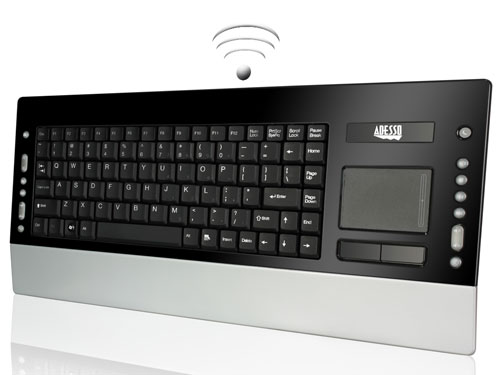
I like my Logitech keyboard, but I have wished more than one time that there were a wireless version of the Illuminated Keyboard when I am fighting with the wire to get the keyboard just where I want it. There are some uses, like for a HTPC, where wires simply won’t work. If you are looking for a nice wireless keyboard that is perfect for use from the couch, the Adesso WKB-4200UB may be perfect.

adessowkb4200ub sg

The keyboard uses 2.4GHz wireless tech with 12 channels that it can change automatically to prevent interference. Wireless range is 30 feet and the keyboard has a small USB receiver. The best feature of the keyboard for the HTPC user is that it has a two-button track pad on the right side rather than a number pad.

That means you can type and control the mouse from one device. Power comes from a pair of AAA batteries and the keyboard has a switch to turn it off when not in use. The WKB-4200UB is available now for $119.99.

Monday, 1 February 2010

Onkyo TX-SR607 Home Theater A/V Reciever Review


As a professional Home Theater installer / designer I have used hundreds of Home Theater A/V Receivers over the years. I'll keep this short and sweet and not get into tech specs.

First let me start off by saying that this is where most electronics retailers "get you". A/V Receivers and Speakers are where consumers can be guided into products that they don't need or that use antiquated technology, simply to increase profit margins for the dealer. Many A/V Receivers simply don't have the features you need for taking full advantage of all the new Home Theater components available today. DO NOT let your self get talled into an over priced Receiver because of it's brand name. Take Marantz for example: Their entry level home theater receiver at a list price of $849 only has 3 HDMI inputs. So, you connect a Blu-ray player, an HD Cable or Satellite Box and a XBox 360. Now you're out of HDMI Inputs, and when you're ready to add a new PS3 for your child's birthday you're stuck!


Enter Onkyo TX-SR607!

Excellent sound quality, SIX HDMI inputs, onboard Dolby TrueHD and DTS-HD Audio decoding and MORE. The TX-SR607's six HDMI inputs are unheard of at the price range. We've previously only seen six HDMI inputs on very high-end receivers and sound quality comparisons to a Denon AVR 3808CI receiver ($1,699 MSRP) are too close to call.

We have used almost every brand and model of A/V Receiver on the market.  You may find this hard to believe, but, this unit is almost a one fits all product. Don't get us wrong there are several reasons to use other products, the need for more power in some cases. But, for most home theater systems this one hits the nail on the head.

The bottom line: The Onkyo TX-SR607 offers a ton of HDMI connectivity and excellent sound quality for a mid range Mid priced AV receiver. You can spend more, but you have to spend much more to out-preform this product.